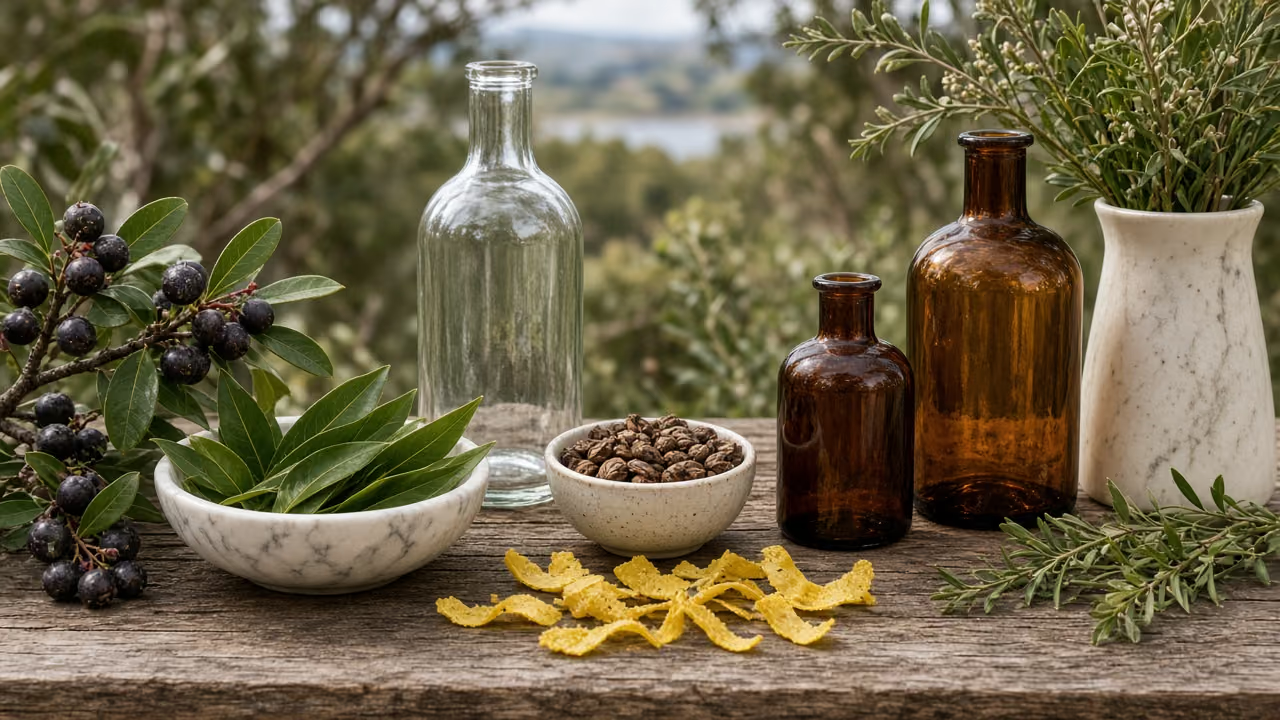
Local bottles
Australian makers
Australia now makes vermouth and bitter aperitifs worth putting on an aperitivo tray. This hub names only producers whose own sites state what they make.
At a glance
- Four verifiable makers
- Named here
- Vermouth and bitter liqueur
- Category
- Primary source or silence
- Rule
- None
- Rankings
Italian bottles taught the grammar. Australian bottles are allowed to speak it with native botanicals and local wine. This hub is a citation list, not a trophy case. If we cannot point at the maker’s own page, we do not print the name.
We also do not list bars. A producer is a bottle you can verify. A venue is a business that opens and closes. Different jobs.
Maidenii
Maidenii publishes a range of vermouths, including a Dry designed for a Martini-shaped serve and a Roselle that the maker describes as an aperitivo-leaning bitter style. The site discusses Australian native botanicals — among them strawberry gum, Tasmanian pepperberry and saltbush — over a wine base. It also points to The Book of Vermouth by Gilles Lapalus and Shaun Byrne. We take those as the producer’s own words, not as a review score.
Use Maidenii where a recipe calls for vermouth and you want the botanicals to be local. Name the style on the table (Dry, sweet, Roselle) so guests know what they are tasting.
Regal Rogue
Regal Rogue calls itself an organic Australian aperitif maker and dates that work to 2011. The varietals page describes organic Australian wine and indigenous botanicals, and publishes style notes for bottles including Daring Dry and Bold Red. It also publishes the storage rule we repeat elsewhere: refrigerate after opening and consume within 60 days.
That storage line is why this producer appears in the vermouth hub as well as here. It is a primary instruction, useful to anyone who has ever left a sweet vermouth in a warm cupboard.
78 Degrees Distillery
78 Degrees publishes a Dry Vermouth built on McLaren Vale Chenin Blanc, with a botanical list that includes karkalla, wattleseed, native thyme, sunrise lime, lemon myrtle, anise myrtle and finger lime. The page discusses Adelaide Hills Distillery as the originating name. We repeat what the product page states and we do not add medals or scores.
A dry vermouth with salinity and citrus natives is a natural on-ice aperitivo, and a legitimate stand-in when a recipe wants dry vermouth rather than a named European brand.
Marionette
Marionette is not a vermouth maker. It is included because the producer publishes a bitter curaçao — an orange-led bitter aperitif — and prints Negroni- and Americano-shaped recipes that use it in the bitter slot. The site also publishes orange curaçao and blue curaçao. If you use the bitter bottle in a Negroni template, call it a Marionette Negroni, not an IBA Negroni. The IBA drink specifies Campari.
How to put these on a tray
- One Australian vermouth on ice with orange or lemon is already aperitivo.
- A Spritz that uses an Australian bitter instead of Aperol is a spritz, not the official IBA Spritz. Say so.
- A Negroni that uses Australian sweet vermouth and still uses Campari remains in the IBA family of method, with a local wine.
- Do not invent a “native botanicals ranking”. Taste, name the bottle, cite the page.
The long guide is Australian aperitif makers.
What a local bottle changes in an official drink
The IBA Spritz names Aperol. The IBA Negroni and Americano name Campari and sweet red vermouth. You may pour an Australian vermouth in the wine slot and still describe the method as Negroni or Americano. You may not pour an Australian bitter in the Campari slot and keep the official name. That distinction is the whole honesty of this hub.
A local dry vermouth on ice needs no official name. It is the cleanest way to taste pepperberry or myrtle without a gin perfume on top. If guests ask what they are drinking, hand them the producer URL, not a poem.
What we are not doing with “native botanicals”
Pepperberry, lemon myrtle, wattleseed, saltbush and karkalla appear on the pages linked above. They are ingredients. They are not a ranking category and they are not a guarantee that a guest can blind-taste “Australia”. Describe what you taste. Do not invent a terroir essay the maker did not write.
The citation rule, again
Producers disappear, rename, and change recipes. This page will only be as good as the links. If a page dies, the name should come off until a new primary source exists. If you make an Australian bitter or vermouth and want it considered for a future update, write to the editor with the product URL — not a press claim about awards we cannot see. The long reading of the same four pages is Australian aperitif makers.
What people ask first
Are there Australian vermouth producers?
Maidenii, Regal Rogue and 78 Degrees Distillery all publish vermouths on their own sites. They are not ranked here.
When did Regal Rogue start?
Is Marionette a vermouth?
Marionette publishes orange and bitter curaçao liqueurs, including a bitter curaçao it uses in Negroni- and Americano-shaped recipes.
Why aren’t more brands listed?
Absence is not a judgement; it is a citation rule.
Pitch a drinks or food guide
Guest posts that teach a recipe, a pairing or a producer — with primary sources — are welcome. We do not publish venue round-ups or invented rankings.