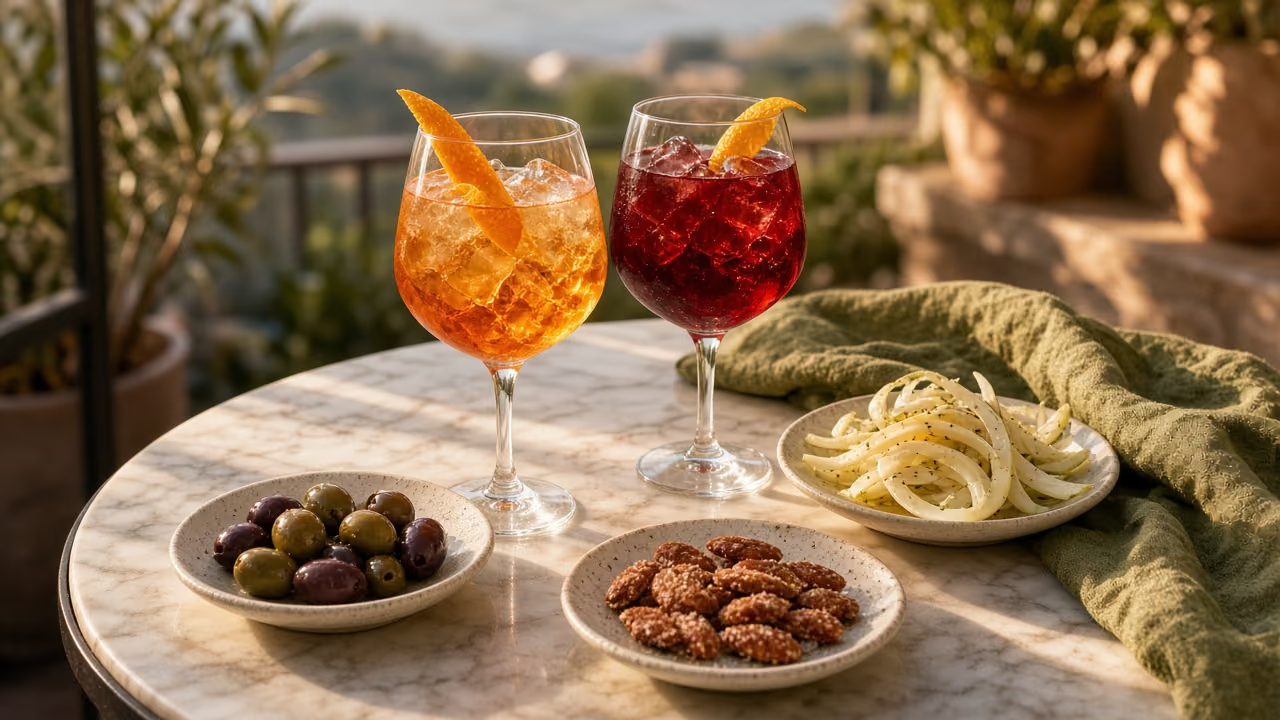
The ritual
What aperitivo is
Aperitivo is the Italian name for the hour that opens dinner. It is a bitter drink, a small plate, and a social pause — not a second meal and not a happy-hour discount.
At a glance
- Aperire — to open
- The verb
- Bitter, not dessert
- The drink
- Salt before supper
- The bite
- Then you eat
- The stop
Ask an Italian what aperitivo is and you will usually get a time of day before you get a recipe. The word is doing social work. It means now we stop. It means now we taste something bitter. It means dinner is coming, and we are not going to ruin it.
The etymology is not decoration. Italian aperitivo sits on Latin aperire, to open. The drink is supposed to open the stomach and the conversation. That is why the flavour leans bitter rather than sweet, and why the food is a nudge rather than a main. A cream cocktail or a sugar-heavy mixer can close the palate. A bitter orange, a wormwood wine, a chinotto note, a splash of soda — those keep it ajar.
Aperitivo, apéritif, digestivo
English borrows two neighbouring words and then muddles them. The French apéritif is a category: a drink taken before the meal. The Italian aperitivo is a category and an appointment. You can drink an apéritif alone at a kitchen bench. Aperitivo, in its ordinary Italian use, implies other people, a counter or a table, and a small plate that arrives with the glass.
After the meal the job reverses. Digestivo — amaro, grappa, a sweet liqueur — is the close of the evening, not the opening. A Fernet after pasta is not aperitivo, even if the bottle is Italian and bitter. Timing is part of the definition.
This site keeps the Italian word because the ritual is Italian. When we say aperitif we mean the broader European category, including vermouth and aromatised wine drunk without the full social hour.
What the hour contains
Three pieces, in order.
The drink. Lower in alcohol than a nightcap, built to be finished while the ice is still honest. The IBA’s Spritz, Americano and Negroni are the three official cocktails that most clearly belong here. A glass of dry vermouth, a Campari and soda, or a bitter alcohol-free soda can do the same job.
The bite. Something salty, fatty or pickled. Olives, nuts, cheese, bread, a vegetable that has seen oil or vinegar. The food is there to make the bitterness make sense, and to stop the drink landing on an empty stomach. See food pairings.
The stop. You leave for dinner. If the snacks become a buffet and the drinks become a session, you have slid into apericena — a real, later Italian habit in some cities, but a different thing. This guide does not treat “bottomless snacks” as the classic form.
What it is not
It is not happy hour. Happy hour is a commercial discount. Aperitivo can happen in a bar that also runs specials, but the ritual does not require a special. It requires bitterness, a bite and a before.
It is not a cocktail party. You do not need six drinks, a playlist or a theme. One well-made glass and a bowl of olives is enough to be correct.
It is not a restaurant review. An earlier life of this domain pointed at a dining room. That is not what this rebuild is for. We do not list named bars as operating, and we do not invent opening hours.
How the ritual sits in Australia
Australia already has the weather and the social shape. Late light, a balcony, a bowl of something salty, a cold glass — the country does this without needing a manifesto. What the Italian word adds is discipline. The drink is bitter on purpose. The food is small on purpose. Dinner remains the destination.
The clock should be local. If your household eats early, move the tray earlier. If you eat late, you have a longer window. Weekend lunch can take an aperitivo too: a spritz before a long afternoon table is the same grammar as a spritz before a late dinner.
Climate is a better teacher than fashion. In heat, ice and soda and citrus are kind. In cold, a stirred Negroni or a red vermouth on a large cube is kind. Neither choice is a ranking.
A note on stories we will not tell
Aperitivo attracts origin legends — Roman tonics, Habsburg spritzes, café myths with a count at the bar. Some of those stories are published by brands; some are folklore. This page will not turn folklore into fact. Where a year is given later in this site — Carpano’s vermouth in Turin in 1786, Gaspare Campari’s bitter, the Barbieri brothers’ Aperol in Padua in 1919, Regal Rogue’s start in 2011 — it is because a primary producer or brand history states it. Where we cannot see the primary page, we stay qualitative.
How to begin tonight
You need one bitter element, one cold element, and one salty element. That can be as small as vermouth, ice and olives. It can be the IBA Spritz if you have Prosecco, Aperol and soda. It can be a bottled bitter soda and a piece of cheese if you are not drinking. Put it on a tray so it feels like an hour rather than a raid on the fridge. Then eat dinner.
For the drinks themselves, go to cocktails. For the bottles, go to bitters and vermouth. For the tray, go to hosting. If you want the long, citable versions, the guides are written to be quoted — answer first, sources attached, no invented numbers.
What people ask first
What is aperitivo?
It names both the hour and the glass.
Is aperitivo the same as an apéritif?
What time is aperitivo?
Translate the function to your own mealtime rather than copying a single Italian clock.
Is apericena the same thing?
Apericena is a later, heavier, more commercial spread that can replace dinner. Classic aperitivo is a prelude, not a substitute.
Pitch a drinks or food guide
Guest posts that teach a recipe, a pairing or a producer — with primary sources — are welcome. We do not publish venue round-ups or invented rankings.